
The Sleeper's Sleeper: An Iron Road to Energisation
Why the fastest route to a connected data centre was built by the Victorians; this one's an argument for running Britain's power and fibre beside its trains.

If there’s something which is quickly becoming apparent to anyone who’s trying to rapidly build out any form of major infrastructure project in the UK, it’s that most of Britain’s power and connectivity infrastructure is significantly overdue for replacement. The grid connection queue sits north of 700GW; developers are being offered energisation dates in the late 2030s; and a recent Neos Networks survey found that 82% of UK data centre operators have delayed builds or expansions because they can’t get the fibre they need. Nscale’s £2bn Essex campus, the flagship of the government’s AI ambitions, is stalled because the power won’t arrive in time. I’ve written before about why the UK should mesh its compute rather than chase megacampuses, but whichever model you favour, the same problem sits underneath: we cannot build linear infrastructure, cables, quickly enough to connect anything to anything.
There’s the counter-argument too; a lot of operators are generally aggressively pursing on-site generation as an alternative. But, there’ll also come a point where possibly not all of that energy will be utilized on the data center site – in which case, it may be better generated and redistributed back throughout the grid. So there’s still an argument that we still need to get power from the data centers to the rest of the community, even if they’re generating it themselves.
We could try a deliver a new scheme to cover the entirety of the country with new cabling – engage with landowners, dig some trenches, and lay some new cables. However, we’re not very good at that delivery of large scale infrastructure projects cough HS2 cough.
That’s the modern summation of our ‘track’ record, and it’s something we utterly failed at. So multi-stakeholder engagement isn’t going to be the way around getting something delivered in a timely manner. But rail infrastructure does provide a line of thought worth considering.
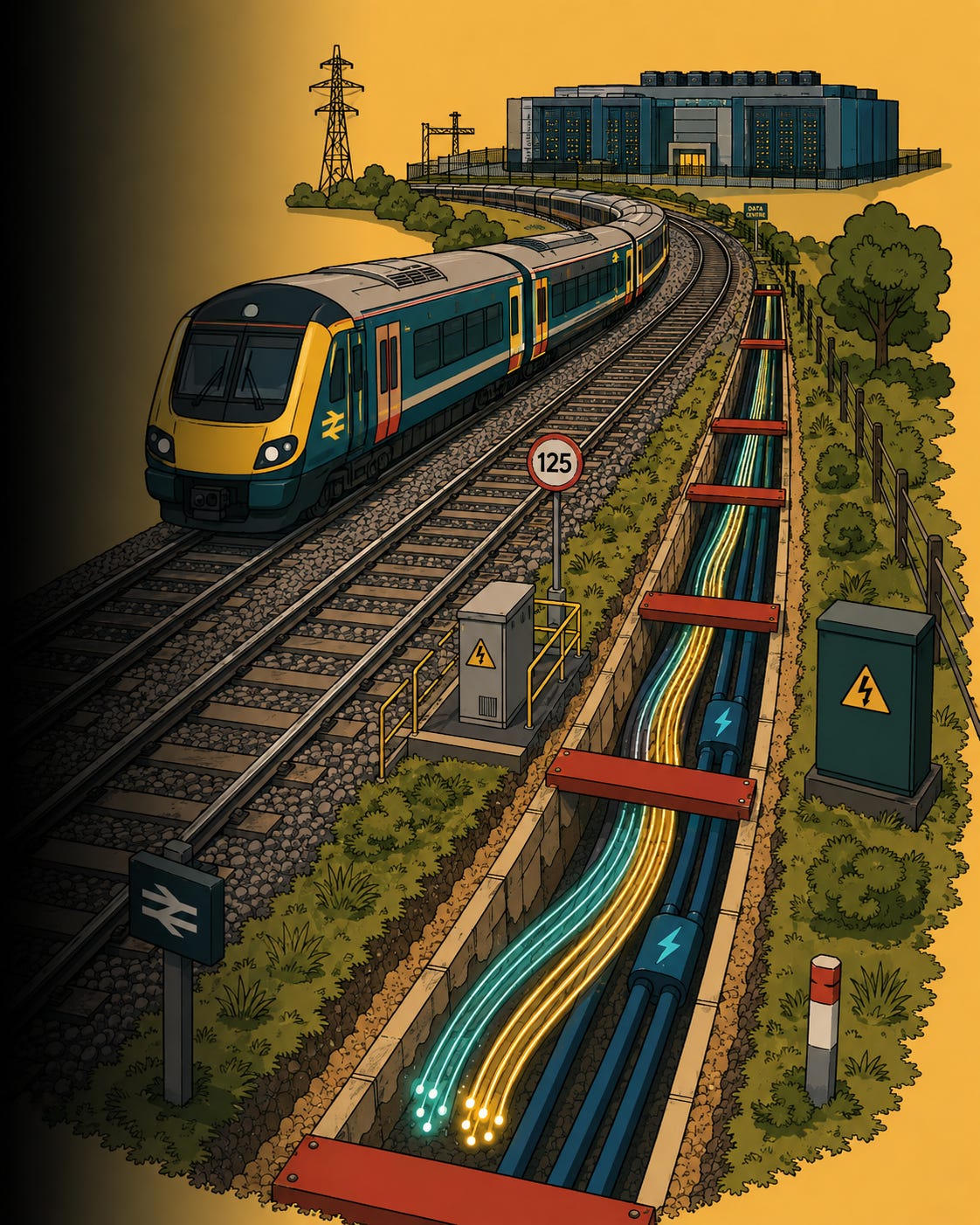
Whilst everyone stares at the connection queue, wondering how long it’ll take to get power from the station to the site, we’re ignoring a linear asset that already runs to every major city and most of the towns in between; that’s fenced, secured, surveyed and owned by a single organisation; and that was purpose-built for moving heavy materials long distances. The railway. Half the hard work of any linear build is assembling the route, and the Victorians finished that job for us over a century ago. My argument here is simple: the rail corridor should become the default route for the fibre and power cabling this country desperately needs, and the railway itself should be the machine that delivers it.
The route of the problem
The engineering of burying a cable is well understood; the hard part is the route. A new overhead line or buried circuit crossing open country negotiates with every landowner, tenant farmer, and occupier along its length. Each one gets consultation rounds, access agreements, compensation negotiations, and mitigation works. I’ve represented clients with National Grid lines passing over their land, and I’ve seen how slow that process works from the other side; consultation and scheme delivery run on timescales that would embarrass a medieval cathedral builder, and that’s with a statutory undertaker holding compulsory purchase powers. Multiply one slow negotiation by several hundred ownerships per route and you understand why new transmission schemes take a decade before a spade touches soil.
Now run the same exercise along a railway. One landowner, end to end. Network Rail holds roughly 52,000 hectares, and, from my own experience of dealing with them, its in-house property and surveying teams are set up for exactly this kind of transaction; they deal with wayleaves, easements and boundary matters as business-as-usual, and they’re straightforward to work with. One counterparty means one negotiation, one access regime, one fixed price per metre; no severance claims, no crop loss schedules, no ransom strips. The corridor is already fenced and secure, so the only people near your cable are contractors who are already safety-trained to be there.
The permanent way to do it
None of this is a novel fantasy; it’s arguably the oldest trick in telecoms. The Victorian telegraph ran beside the tracks because the railway was the only assembled corridor in existence. Sprint is literally an acronym: Southern Pacific Railroad Internal Network Telecommunications. The railroad laid around 15,000 miles of fibre along its own right-of-way in the late 1980s, using its own construction train to do it. And in the US today, the SOO Green HVDC Link is a 350-mile, 2,100MW buried transmission line routed 90% inside a single railroad’s corridor, structured that way specifically to avoid negotiating easements with hundreds of landowners. The trench is about a metre wide. That’s a gigawatt-scale power line in a slot narrower than a garden path.
Britain has started down this road for the fibre half. Project Reach, signed in June 2025, sees Neos Networks deploying 1,000km of high-count fibre along the East Coast Main Line, Chiltern, and parts of the West Coast and Great Western routes, explicitly to connect business hubs, data centres and subsea landing stations, with ambitions beyond 5,000km. Network Rail Telecom already operates close to 20,000km of fibre; apparently the third largest network in the country. So the question isn’t whether the corridor works for cabling. It demonstrably does. The question is why we’re only using it for the easy half.
Power is the unfinished business, and I’ll be honest about the limits before anyone else points them out. A rail wayleave solves routing; it does not solve grid capacity. If your scheme needs a transmission connection, you’re still in the queue, and no amount of Victorian earthworks changes that. Where the corridor earns its keep is everything the queue doesn’t cover: private-wire links running from generation sites directly to data centre campuses, distribution-level connections, and the interconnection of smaller meshed sites of exactly the kind I argued for in previous articles. SOO Green proves the engineering; so that just leaves the commercial logic to be implemented.
Night mail, new tricks
The railway also has a second distinct advantage – it’s got it’s own integrated construction system. Any other linear project has to build its own logistics: haul roads, laydown areas, with hundreds of aggregate lorries driving through villages (that after a week, absolutely hate you and everything you’re building). But in this case, the railway is the logistics. Cable drums, ducting and backfill aggregates arrive by engineering train; spoil leaves the same way. Sprint’s construction train proved this model forty years ago; nothing about it has dated.
The workflow already exists. Network Rail runs continuous repair and upgrade works every week of the year; possessions, isolations, and night working are standard operating procedure, not an exotic request. From what I’ve seen of how they work, plugging a trenching programme into that machinery is a feasible extension of business-as-usual, not a new discipline.
The clock runs at night. Lineside works can run during engineering hours and overnight possessions, 24/7 where the programme demands it, without touching the timetable. Try getting a wayleave that lets you work through the night across any other private land. Properties are typically build away from most of the railway network, so much of the other stakeholder gripes are already addressed by design and location.
A trencher eats linear metres. A specialist rail-mounted or lineside trencher working an unobstructed corridor should achieve a daily metreage that open-country schemes, with their access constraints and reinstatement obligations, can’t even begin to touch. Add that to the additional capacity of engineering trains over lorries, and thousands of meters of cabling could be laid every night. This could be a scheme that could be delivered in record time compared to other recent British attempts.
I should probably temper the estate-agent gloss, because I’ll accept that the railway corridor is less generous than the map can sometime suggest. The boundary can be narrow and fragmented, depending on the railway section itself; cuttings, embankments and structures can eat into the width, and those can be congested with existing signalling and telecoms troughing. Scanning and detection of existing infrastructure that’s installed will nbeed to be on point.
That level of asset protection is a real regime with real costs, too: roughly 20 weeks of notice, and the applicant pays for everything including the safety staff watching you work. One landlord, yes; but a demanding one with a railway to run. Rather than pretending that friction away, it just needs to be systemized – there’ll be a few teething problems for the first part of the scheme; but thereafter, it should be just be a procedural rinse and repeat. 20 weeks isn’t necessarily fast; but still significantly faster than a currently quoted 2033 connection date via other means.
Ghost stations, live wires
There’s another final piece of potential in this scheme - the Beeching era left the network littered with closed stations, redundant goods yards and disused sidings; parcels of railway land sitting next to a live corridor, many with hardstanding, road access and a community that stopped noticing them decades ago. These are natural homes for the nodes a cable network needs: connection compounds, battery storage, and substations serving both the railway and whatever the corridor now feeds. The government has already gestured at this, announcing plans in April 2026 to squeeze 10GW of renewable capacity from public land, railway land included, and commentators have pointed out that fragmented lineside plots suit battery storage far better than they suit anything else.
Another caveat before anyone gets too carried away: I’m aware that a node site doesn’t conjure the kit that goes on it. I’m aware that even if we roll out a whole new set of cabling in record time, Power transformers are running lead times of 128 weeks and up, and switchgear is effectively sold out through 2028, so repurposed goods yards join the same procurement queue as everyone else. But land with grid adjacency, road access and a single public landlord is precisely the land that queue-jumps every other part of the development process; the transformer arrives no faster, but everything that usually waits for the transformer is already done. Think of this as an efficient way to build out the infrastructure in parallel; we can’t connect the transformer until the cabling is laid anyway – so it makes sense to put the cabling in whilst we’re waiting for the transformers to be bui;lt.
Two hundred years ago we built the railway to move coal to where the work was. We’ve still got the same issue, and the same macro-requirement, but work is different now: it’s compute, running on electrons and photons rather than steam. But fundamentally the corridor is the same corridor; and it’s sitting there, fenced, and connected to everywhere that matters – and it makes far more sense to me to utilize that rather than we queuing politely for permission to dig up fresh ground with far more blockers in the way.
I also accept the hard version of this argument; bulk transmission by rail corridor, needs National Grid, Ofgem and Network Rail in a room agreeing things which historically regulators are slow to agree. The soft version needs a wayleave, a trencher, and a fixed price per metre. But we’ve already done it with fibre optics, so now it’s just a case of replicating it with power.
TH