
The Elephant on the Quay: Can Shelf Prices Survive the Sea?
Ports are the grid bottleneck of physical goods, and we've underinvested in them for long enough - but that rent may soon be due...

In previous articles, I've spent a fair amount of words arguing that the power grid is the real bottleneck of most industries; and in specific, the archaic infrastructure and grid network. Decades underinvested, a queue of projects nobody can connect, and every clever idea downstream of it eventually choking on the same constraint.
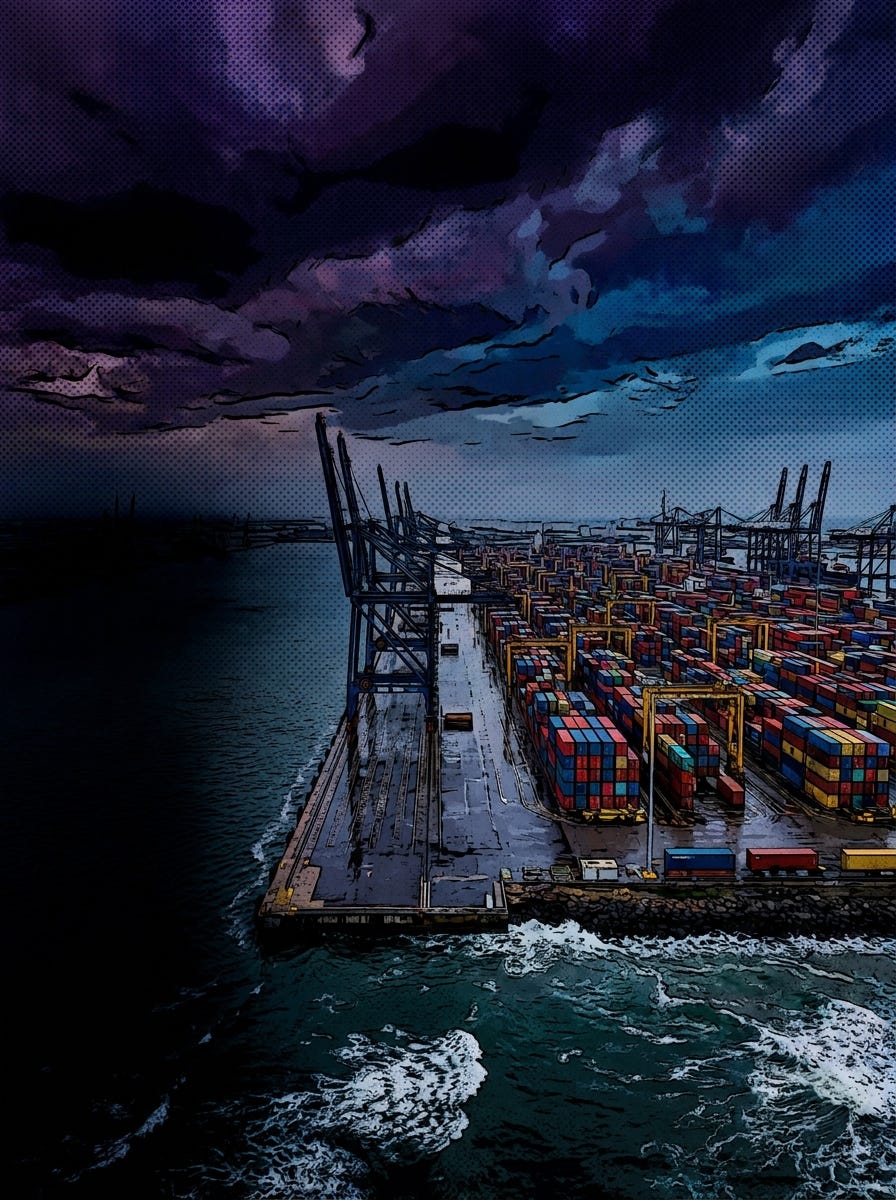
There’s a second grid that almost nobody talks about in those terms. It’s made of concrete, cranes and seawater, and it carries the physical economy the way the electricity grid carries the digital one. We call its junctions “ports”. And like the power grid, it’s over-concentrated, under-invested, and quietly setting the price of nearly everything you own.
Here’s the part that should bother you more than it does. That grid sits at the water’s edge, which is precisely where the weather is getting worse.
An invisible grid where you can’t see the pylons
Over 80% of world trade by volume moves by sea. In 2024 that was around 12.1 billion tonnes of stuff loaded onto ships [UNCTAD Review of Maritime Transport 2024]. IN realistic terms, that is not a slim majority, it’s pretty much all of it. Everything in your kitchen, your car, the components inside the phone or computer you’re reading this on, all of it spent part of its life on a boat.
But they didn’t pass through a thousand evenly-spread harbours; it funnelled through a relatively small number of mega-ports and a handful of canals and straits that the whole system leans on. You’ve experienced some of the repercussions of this setup already in recent times - remember when the Suez canal got blocked in 2021? Or when prices shot up due to the Russia/Ukraine conflict? And we’re all only just seeing the tide turn on fuel prices now the Strait of Hormuz has reopened following the peace deal between Iran and the USA.
This is the elephant on the quay - we’ve built a global economy that depends on a few dozen enormous, fixed, coastal ports and passages, and then we’ve assumed they’ll always be open, and always be accessible.
This is the same mistake we make with nearly everything. I’ve written about it at length in the context of hyperscale data centers, and I’ve argued at length why distributed beats giants in manufacturing. The premise of concentrating the load into a few big sites and you end up building spectacular efficiency on top of spectacular fragility. One bad day at one critical node and the delay ripples through everything plugged in behind it.
The difference is that a substation or a data center is affected largely by controllable factors – most things can be planned, scheduled or accommodated in advance. Security can be tightened, redundancies built into systems, fast re-routing of traffic or demand. They aren’t really affected by many uncontrollable factors, such as the the weather – they’re largely unaffected by a storm surge.
But a shipping port does.
High and dry, and underwater too
When people picture weather risk to ports, they picture the obvious version. A hurricane, a flooded terminal, containers floating off into the harbour. That happens, and it’s expensive. But the more interesting risk is the one that works in the opposite direction - drought.
Look at what happened to the Panama Canal. An extreme drought through late 2023 dropped the level of Gatun Lake, the freshwater source the locks depend on, so far that the canal had to ration itself. Daily transits fell from roughly 36 to 38 vessels down to around 18 by February 2024. Ships either waited, paid enormous sums to jump the queue, or sailed thousands of extra miles around the bottom of two continents. It took until late 2024 for capacity to recover. No storm. No flood. Just not enough rain in the wrong place, throttling a chokepoint the entire western hemisphere relies on.
The Rhine told the same story in 2022. A hot, dry summer dropped water levels so low that barges could only sail about a quarter full, capacity on Germany’s main commercial artery roughly halved, and operators slapped low-water surcharges on everything moving through. Chemicals, coal, grain, fuel. An entire industrial economy partly seized up because a river got shallow.
The climate now disrupts trade by giving us too much and too little water, sometimes in the same year, and the infrastructure that was built for a band of conditions we’re sliding out of at both ends.
Hit at both ends of the chain
Now layer the two together, because the weather doesn’t politely attack one link at a time.
In 2011, Thailand flooded. Thailand also happened to make a huge share of the world’s hard drives, somewhere between a quarter and 45% of global output depending on whose figure you take. Factories went underwater, and the world hard-drive output fell by as much as 30% in the final quarter of the year, and average drive prices jumped around 150% in the space of about six weeks. It took roughly a year for supply to recover. A flood on one floodplain in South-East Asia, and people in London and Los Angeles paid more for storage for a year.
This is the part that the shelf price never shows you. Weather can hit the factory at the source and the quay in transit and the port at the destination, and each hit compounds the last. The cost lands as a vague “supply chain issue”, gets folded into a freight rate nobody itemises, and arrives at the till as a number that’s just slightly higher than it used to be, with no label explaining why.
The premium on the premiums
This is where the hidden cost stops being a one-off shock and becomes structural, because there’s an industry whose entire job is to price exactly this risk - Insurance.
If you want to know where physical climate risk is going, don’t read the forecasts, read the insurers. They’ve already shown their hand on land. Insured losses in the US hit $112.7 billion in 2024, up about 36% on the year before. Carriers have simply walked away from the worst-exposed homes in Florida and California, with multiple insurers exiting or freezing new policies across 2022 and 2023. When the maths stops working, they don’t raise the price, they just leave.
Coastal port infrastructure sits on exactly the same risk curve. Sea-level rise, storm surge, heavier rainfall; all concentrated on assets that by definition can’t move inland. Marine cargo and the business-interruption cover behind it are repricing accordingly. And here’s the death spiral worth naming clearly: a port that becomes uninsurable is, for all commercial purposes, a port that’s closed. Nobody routes serious volume through a node they can’t insure. The premium becomes the price of trade, until one day the cover just isn’t offered, and the route quietly goes dark.
That cost doesn’t vanish. It gets spread across the freight rates of every route that’s still open, and from there onto you. You’re already paying a weather premium on your weekly shop. It’s just buried three layers deep in someone else’s insurance schedule.
Reshore, or made nearer?
So we should really accept that we have an equilibrium? If it comes to a point where importing simply costs more than making it at home, then importing is no longer viable?
In theory, yes. There’s a tipping point where the landed cost of an import, freight plus insurance plus delay plus reroute, climbs above the cost of producing the same thing domestically. The trouble is what’s waiting on the other side of that line. For a country like the UK, the honest answer is: not much. The factories aren’t there; and the once skilled workforce has thinned out or retired. And building national-scale capacity from a standing start is exactly the kind of single, enormous project we are reliably terrible at delivering on time.
Which means “produce it at home” is the right instinct pointed at the wrong solution. The answer isn’t one giant reshoring megaproject any more than the answer to compute was one giant data center. It’s the same move I keep coming back to: distribute it, and redesign the smaller thing. Many small local production sites rather than one national factory. Inland dry ports and multi-modal hubs that take the load off the coastal chokepoints. Modular and relocatable handling that doesn’t depend on armouring a single fixed quay against a sea that’s coming up to meet it.
And realistically, the equilibrium for most goods won’t be “home”. It’ll be “nearer”. Shorter sea legs, fewer chokepoints, supply that doesn’t have to gamble on a single drought-prone canal staying open. Made nearer, not made here. It’s less satisfying than full self-sufficiency, but it’s much more achievable.
There’s a genuine win-win in here, if we keep it honest. Build a meshed, distributed, weather-resilient logistics network and you get cheaper, steadier prices and a supply chain that bends instead of snapping.
The elephant on the quay isn’t going anywhere. The least we can do is stop pretending we can’t see it.
TH
You may find these of interest:
Divide & Conquer: Decentralized manufacturing could be the saviour for both employment and commercial real estate

Have we reached peak manufacturing efficiency? If we’re brutally honest, there’s only been a handful of true leaps in progress over recent years. There was obviously the industrial revolution and the production line; industrialised automated manufacturing methods; and more recently robotics and AI integration.
Medical device companies could deliver market domination by using the Bloomberg playbook

Whilst there are many success stories of businesses in the latter part of the 21st Century, one remarkable achievement is that of Michael Bloomberg, who has managed to create, retain, continue to monetize, and develop a significant indispensable piece of technology for every financial institution in the Western world.
Power Surge: The biggest bottleneck in data center construction

As the digital economy continues to rise, it's going to come as no surprise that the capacity and scale of data centers appears to be growing at an exponential rate. Jensen Huang (NVidia) has indicated that there will be around $1 trillion of investment into data centers