
That's not a Wrap: Shooting out of Sequence
Half of this year's data centres will finish late; and a Hollywood 1st Assistant Director could tell you why. Here's a novel take on how a film crew would schedule a data centre build, and why they'd

Distilled down, I’d argue that every Gantt chart is really telling a similar variant of the same lie. For large projects, there’s the typical several hundred bars, strung together by dependencies, every one drawn at the same weight. The schedule is thought of as being largely democratic, but it isn’t really. Somewhere in that flat list sits a single row that defines your end date – but the weakness in the format means that the chart gives it no more prominence than any of the others.
Film production sorted this out a century ago, without a project-management textbook anywhere in the building.

A film schedule doesn’t start with the story. It starts with the stripboard: one strip per scene, the whole lot shuffled out of script order before a frame is shot. Underneath that sits the sheet worth stealing, the day-out-of-days. Think of it as a film schedule equivalent of a gantt chart – the cast members down the side, shooting days across the top, and a code in each cell:
SW when an actor starts;
W when they work;
WF when they finish; and
The code the entire discipline hangs on: H, for hold.
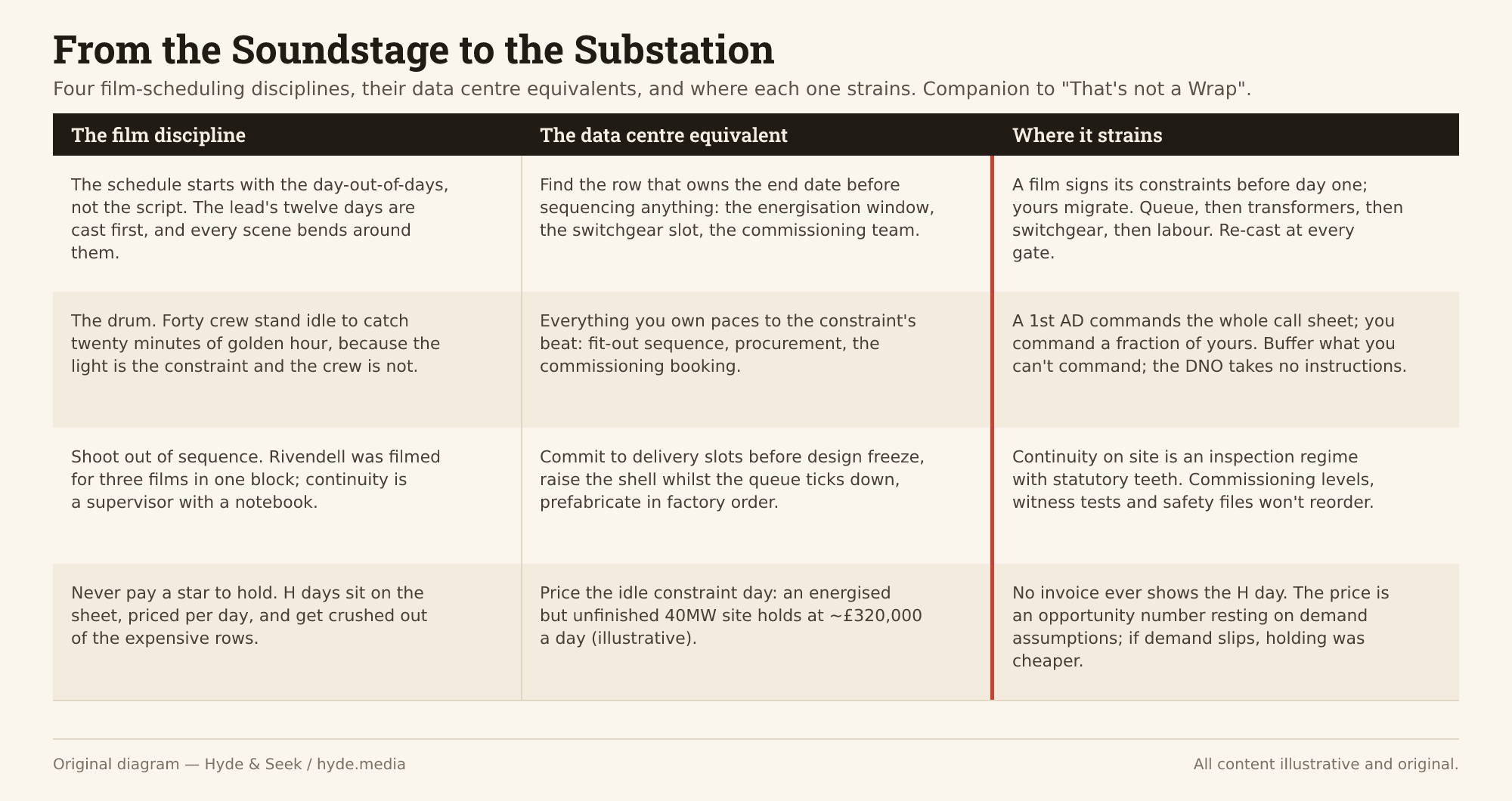
Contracted, paid, and doing nothing. Once an actor starts, the production pays them every day until they finish, trailer days included, so the assistant director’s job is to try and minimize the the ‘H’ days out of the expensive rows. The schedule bends around whatever is scarce, immovable and dear: usually an expensive lead actor, booked for twelve days; or a scarce location for a week; or even could be due to only having daylight for a few hours. The script order is irrelevant.
A popular culture example: Peter Jackson shot Rivendell for all three Lord of the Rings films in one block, because Rivendell was the constraint.
As demand pressures increase on components and materials for data centre build-outs, the construction schedules are quickly mimicking this exact shape; but most are planned as though they don’t.
Casting call
In our context, the ‘lead actor’ on a data centre programme is most commonly the energisation date at the time of writing this article. It behaves like a star booked for a twelve-day window: contracted years in advance, on terms you mostly didn’t set, and if you’re not ready when it arrives, your slot in the supply order queue disappears. In the UK our equivalent of the casting market is brutal; operators who filed connection applications back in 2021 are reportedly being handed energisation dates of 2030 and beyond, with something like 50GW of data centre demand sat in the queue; whilst demand-side connections still run first come, first served. And yet open most programme plans and that date appears as one milestone among hundreds; that’s the equivalent of the star’s name being printed in the same font style as the catering order.
It’s nto a perfectly transferrable practice though, as a production signs its constraints before day one;in our example, the twelve days are in the contract and they stay twelve. In the case of large construiction projects such as data centres though, they migrate. Since 2023, the industry’s binding constraint has wandered from the connection queue to transformers, with lead times reportedly stretching towards five years at the worst, to medium-voltage switchgear that’s effectively sold out through 2028; and now, on many programmes, to commissioning labour. Casting the constraint is a question you now must re-ask at every gate, not a decision you laminate as being absolute and immovable. So I suppose the discipline technically transfers; but the permanence doesn’t seem to.
Waiting for the light
Watch a crew at golden hour and you’ll see the theory of constraints performed live. Forty people stand completely idle so that one camera can catch twenty minutes of usable light; that’s technically the right call - because the light is the constraint, but the crew is not. Goldratt formalised this decades later as ‘the drum’: the constraint sets the beat, everything else subordinates to it – so the theory suggests that an hour lost at the bottleneck is an hour lost for the whole system.
The strain arrives in the same breath, though, because a 1st Assistant Director commands everyone on the call sheet, but in relative terms even as a programme manager, you only command a fraction of yours. The Distribution Network Operator’s calendar, the switchgear vendor’s order book, the local authority planning approvals; all of it sits outside your gift. A data centre programme runs for years across developer, utility, contractors, vendors and tenant, and subordination stops dead at your organisational boundary. But everything you do own: the fit-out sequence, procurement, the commissioning booking etc, all paces to the constraint’s beat; everything you don’t own gets a buffer placed in front of it rather than an instruction issued to it. Pharma tech-transfer teams will recognise the shape instantly: the regulator’s calendar is a drum you play to without ever holding the sticks.
Continuity errors
Reordering is where borrowing too much of the methodology could be dangerous though. So we must recognize it’s limitations. On a film, continuity is simply a supervisor with a notebook, which is why shooting the ending in week one costs almost nothing. On a site, continuity is an inspection regime with statutory teeth. Commissioning runs Level 1 to Level 5 in order; you can’t run integrated systems testing on gear that isn’t energised; and safety files don’t shuffle or have any bypass mechaniusm. A serious chunk of the sequence is physics and law, and no clever board rearranges it.
But equally, a flat Gantt hides how much of the remainder is only habit. Switchgear can be committed before design freeze; manufacturers are in effect selling delivery slots now rather than products, and the slot is arguably the real asset. The shell can rise whilst the queue ticks down. Skids and modules can be prefabricated in whatever order suits the factory, which is rarely the order they’re installed; the same instinct I argued for in manufacturing generally. The test to apply to every dependency line on the chart.
Hold everything
So here’s the instrument, with the borrowed parts and the claimed parts kept separate. The theory underneath, constraints, critical chain, drum-buffer-rope, is decades old and already has a construction literature behind it. The novel take is the film sheet itself ported across – so itt should be judged more as a method, not a proof.
We’ll dub it the “programme day-out-of-days”:
Cast the constraints. List only the resources that idle the whole programme when they sit still. The effective ‘audition’ question for each: if this waits a day, does the end date move a day? For a 40MW UK build that’s the energisation window, the HV switchgear delivery and the commissioning team. If we’ve really attempting to mimic this method, that should be three to five rows. If you’ve got twelve, you’ve just copied the organisation chart.
Draw the sheet. Constraints down the side, months across the top, a film code in each cell: S when the constraint becomes available, W when it’s loaded with real work, H when it’s available and idle, X when two workstreams contend for it at once, B where you’ve deliberately buffered it, F when it’s released. One page. The H and X cells aare effectively displaying the entire finding.
Price the hold. A day of lost data centre revenue benchmarks at roughly $10,000 per megawatt (call it £8,000), so a 40MW site with an energised connection and no finished halls is holding at around £320,000 a day. Against that, the cost of keeping the constraint fed, early procurement carrying costs, stored gear, a commissioning team booked ahead and occasionally underused, might run £4,000 a day. That’s an exchange rate of 80:1, and it means you should cheerfully waste the cheap resources to protect the expensive one. A landlord would call an energised shell with no fit-out a void period; so this sheet should indicate a void before it happens.
Buffer the drum, not the tasks. Strip the padding scattered through individual task estimates and pool it in front of the constraint rows. This is pure critical chain (and I claim none of it!). The limits come with it: buffer-sizing methods are openly disputed, and in construction some padding is priced risk rather than actual waste. A float ahead of utility witness testing is insurance against a seven-figure re-mobilisation; keep that. Pool the padding that’s only padding for the sake of it.
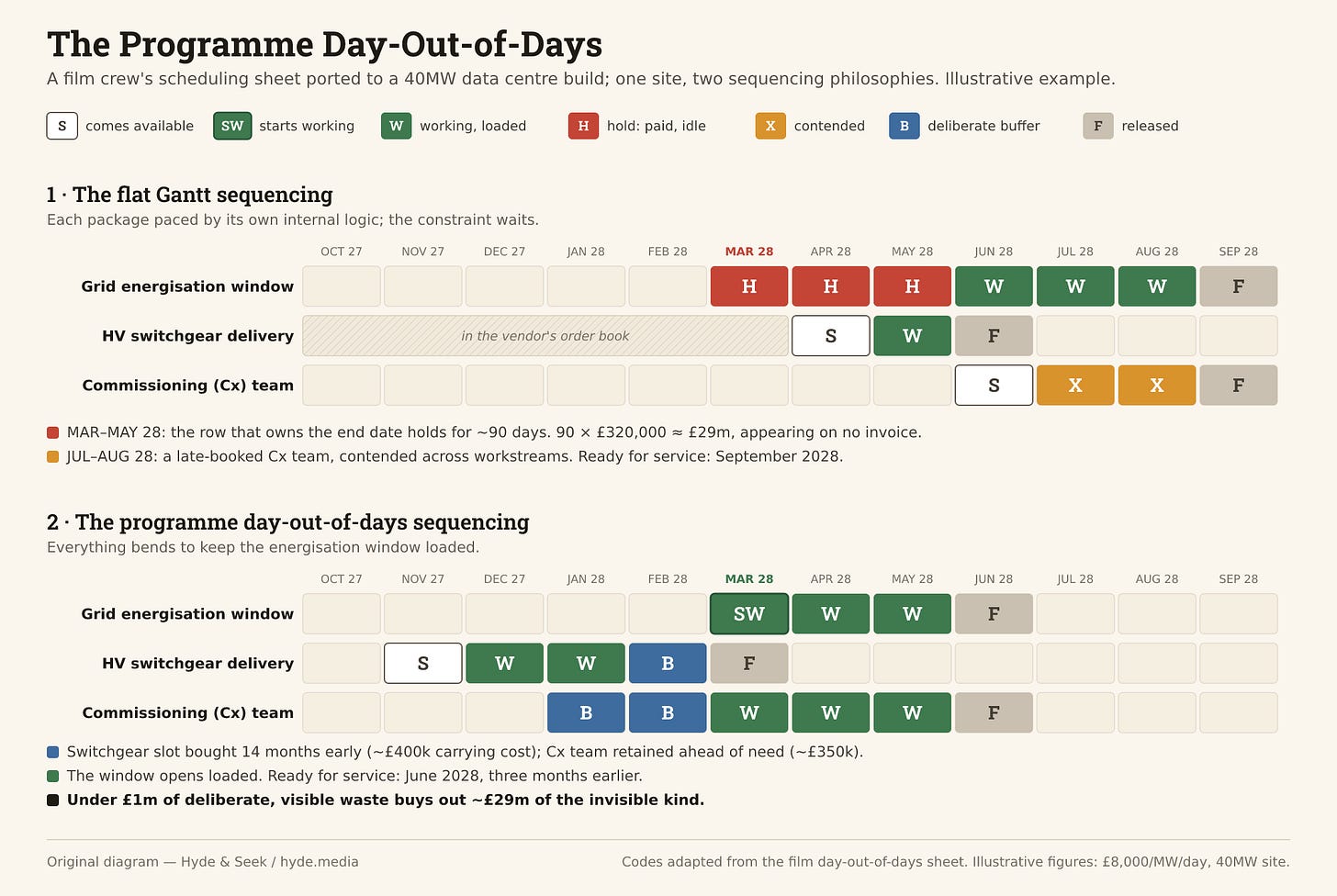
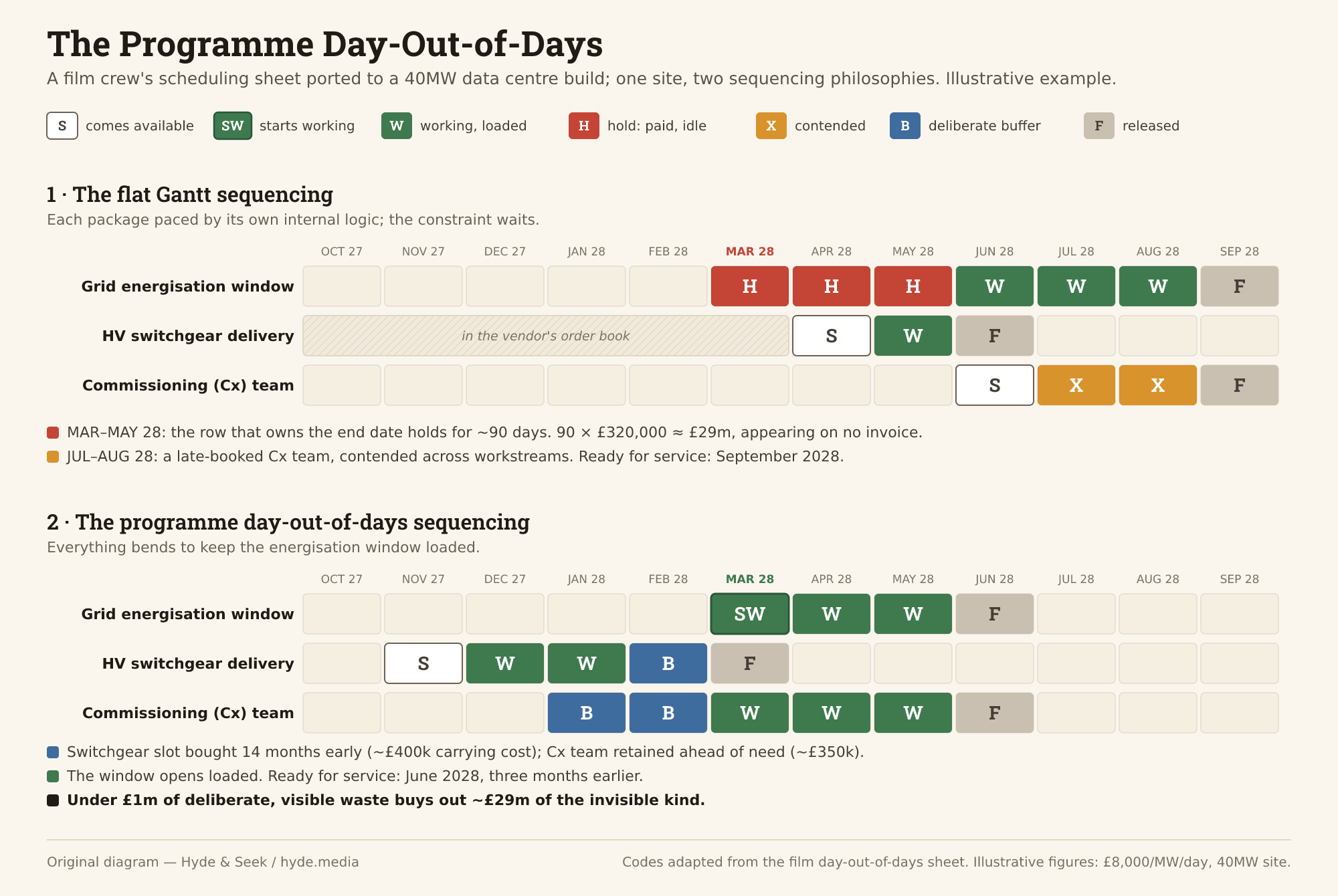
Run the illustrative numbers on our 40MW build and the case makes itself. Flat-Gantt version: fit-out paced by its own internal logic, halls finish three months after the March 2028 energisation slot, and the window holds for roughly ninety days; call it £29 million of H cells that appear on no invoice. Programme day-out-of-days version: switchgear slot bought fourteen months early at perhaps £400,000 in carrying cost, commissioning team retained ahead of need for £350,000, and the window opens loaded. Under £1 million of deliberate, visible waste to avoid £29 million of the invisible kind. There is a caveat that needs to be recognised: that £320,000 a day is an “opportunity number”, mainly resting on demand assumptions. That means that if the demand isn’t there when you energise, theoretically the H cells were cheaper than the hurry. The sheet doesn’t automatically remove that judgement; it’s left for someone to make it in the open.
The martini shot
Film crews call the last set-up of the day the martini shot, because the next glass is at the bar. The industry earned its scheduling discipline the hard way, through a hundred years of paying stars to sit in trailers; meanwhile construction and engineering own the theory shelf, Goldratt and all, and still plan £2 billion programmes as flat lists of equal bars.
The uncomfortable direction of travel is that this gap gets more expensive from here. AI is compressing the flexible parts of every programme I write about, the design hours, the documentation, the engineering rework, whilst doing absolutely nothing for transformer lead times, connection queues or commissioning labour. The immovable constraints are quickly becoming the basis of the whole schedule. So open your programme plan and read it like a call sheet: Find the star; and count the H days. If you can’t see any, they’re not absent; they’re just unpriced, and somebody is likely paying for them anyway.
TH