
Site Unseen: Location, Location, Allocation
Hyperscalers aren't shopping from the same list. Version 2 of my algorithmic method to data center site appraisal; and how a generic approach misprices almost everything.

We’ve reached a rather bizarre climax to data center construction. Sometime this spring, Meta started putting up tents. Not marquees for a launch event; actual fabric structures, erected in a few months, filled with AI hardware and run with barely any backup power. Apparently, that approach roughly halved build time vs a conventional hall. In the same twelve months, AWS deepened its deal to draw 1,920 megawatts from the Susquehanna nuclear plant next door to its Pennsylvania campus. So whilst one of the world’s largest compute buyers decided a tent was good enough, another decided nothing short of a nuclear power station would do.

These are not companies with different levels of ambition; they’re companies with different businesses, and their shopping lists for land barely overlap. Yet the industry still appraises and markets sites as if there’s a single customer out there called “a hyperscaler”, with a single set of requirements, who’ll pay a single fair price.
Last August I published a valuation methodology to try and bring some rigour to this: the Data Center Valuation Suitability Index. Score a site’s power, fiber, water, size and grid proximity, weight each attribute, produce a number out of ten, tie it to local land value. I stand by the mechanics and the intent of doing so. But as every engineer does, I’ve been tweaking it a bit. Version 1 gave the weights as fixed percentages, and the last year of build-out has been one long demonstration that what I defined as constants were actually much closer to variables. So this is the correction, and the upgrade.
Five buyers, five lists
Watch what each operator actually bought this year, and you can reverse-engineer the list they were shopping from.
Meta is the purest case, because it has no customers buying any share of it’s physical infrastructure. Nobody buys cloud services from Meta; the compute serves its own ads and its own models. If a training run drops for an hour, Meta loses an hour, and no bank’s SLA is breached. That’s why it can live in a tent, and it’s why its flagship Hyperion campus sits in rural Louisiana with ten self-funded gas plants behind it - around 7.5 gigawatts of generation, nearly $11 billion of it, a more than 30% addition to the entire Louisiana grid. Meta doesn’t need a ‘good’ site...or certainly not one with all of the faculties that one of the other hyperscalers need. They can manage with just an enormous empty one, as long as there’s plenty of power on tap.
Google is playing a different game, because its campuses aren’t really individual assets. Its private network lets it pool compute across sites and shift workloads between them, so it buys additions to their portfolio, not just a postcode. Its “power-first” model pairs new campuses with dedicated generation, including a Texas campus with a gigawatt of its own supply and a 933-megawatt gas plant that won’t touch the grid at all [according to the Cleanview report on Crusoe permitting]. And because Google also sells latency-sensitive services to the public, it needs the urban and metro sites that some hyperscalers would never need to bother with.
Oracle seems to barely buy any sites at all. Its flagship AI campus at Abilene is a fifteen-year lease on somebody else’s real estate - 1.2 gigawatts running, hundreds of thousands of GPUs, and as far as I understand it, Oracle doesn’t own the ground under any of it. Its weight vector puts almost everything on speed-to-energize and almost nothing on freehold. At the opposite extreme, it’ll install a full cloud region inside a customer’s own building. Oracle has quietly decoupled the operational component from the real estate -- although I was only writing last week how that comes with it’s own risk.
AWS and Microsoft carry the old obligations. They serve banks, governments and hospitals, so redundancy and physical security is contractual, not optional; a tent would be worthless to them at any price. AWS’s answer was to buy certainty, siting a campus beside an existing nuclear plant. Microsoft’s answer, revealingly, was to stop buying: it walked away from a couple of hundred megawatts of leases and froze around 1.5 gigawatts of its own builds while it worked out what its demand actually looks like. When one buyer is erecting tents in a hurry and another is cancelling leases, it’ss a clear indicator that they’re not valuing the same site the same way.
Underneath all of this sits the split I keep coming back to: training siting is more of a power problem, inference siting is more of a location problem. The market now talks about inference in latency tiers, and a site’s assessment has started to refine from a spectral subjective assessment into a discrete basis of categorisation. But depending on their end use case, the side a buyer is hungry for can drastically change what they’ll pay.
DCVSI 2.0: the subscript
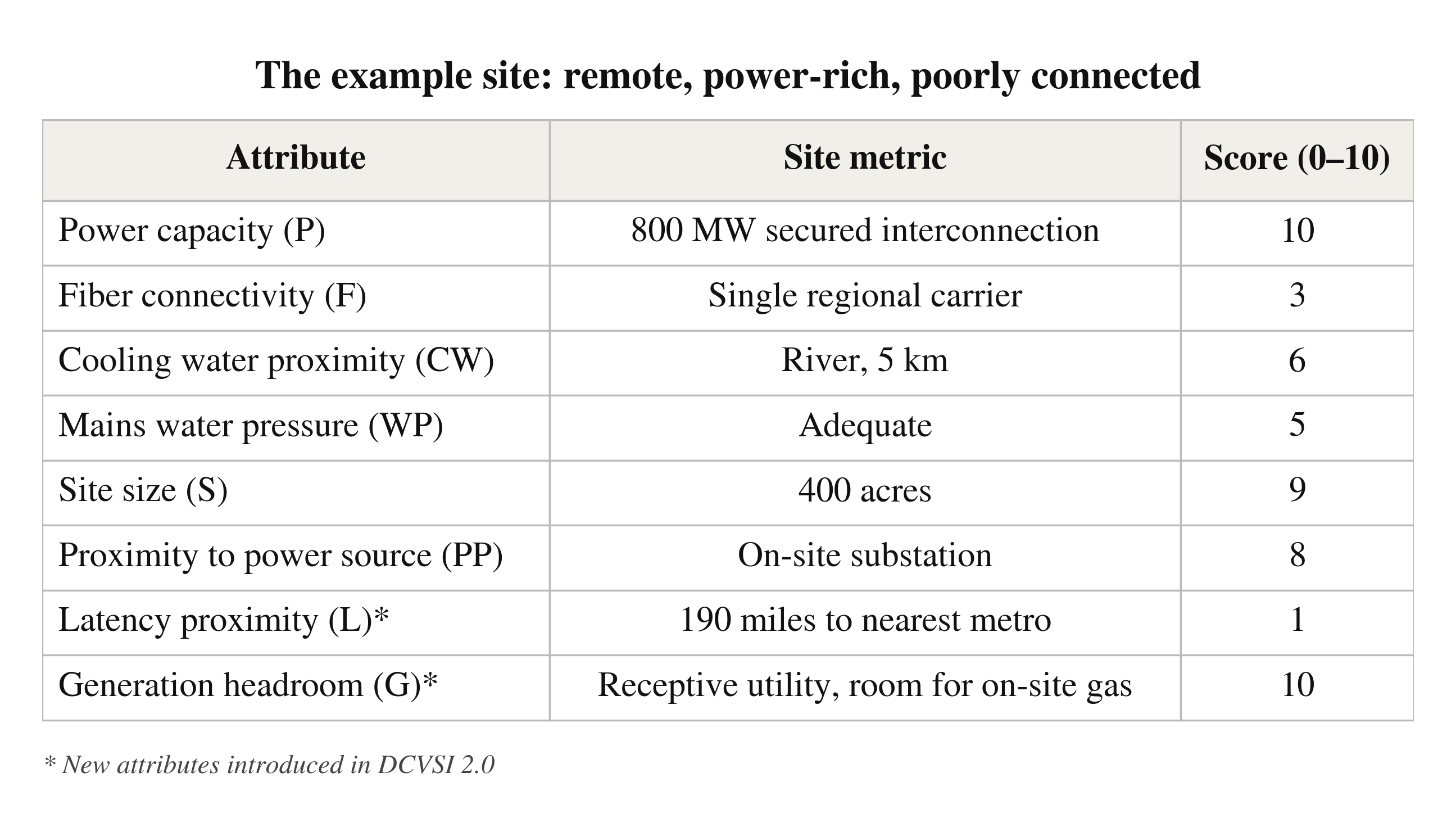
My version 2 is an iterative improvement to factor this in; mathematically it’s only a small change, but I’ll run through it with some illustrative figures. Version 1 said a site’s suitability was:
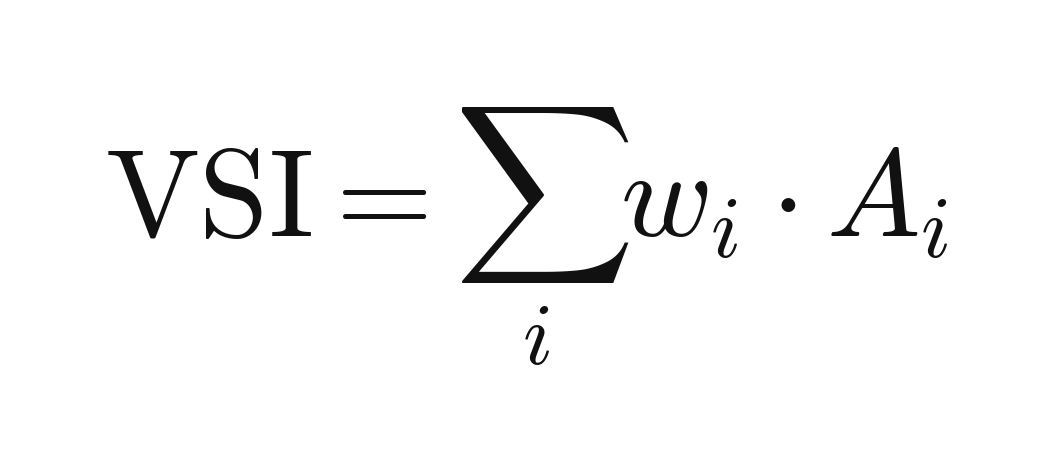
where Aᵢ are the normalized attribute scores (power, fiber, cooling water, water pressure, size, grid proximity) and wᵢ the fixed weights. Version 2 adds a subscript:
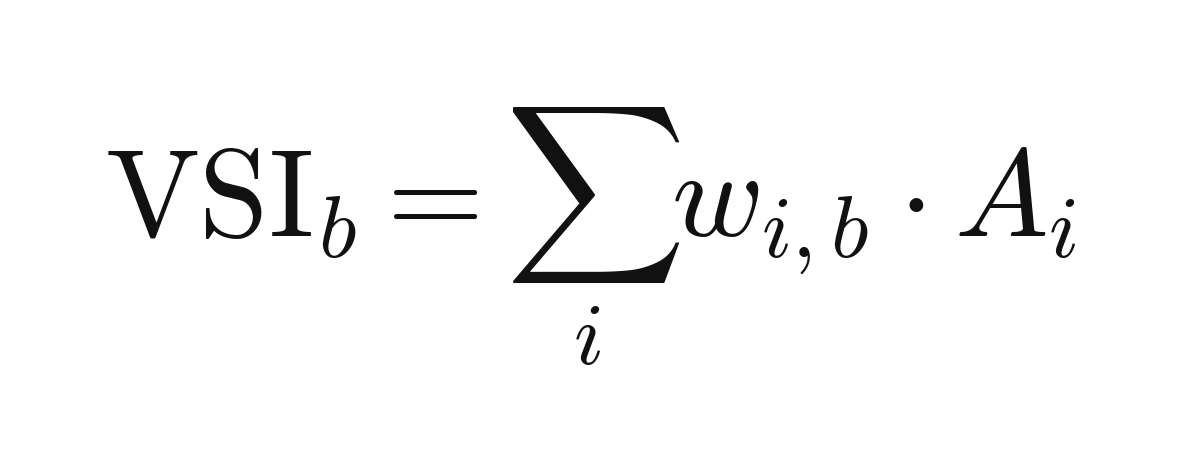
The attributes don’t change; and the weights belong to the buyer, b. Every operator carries its own weight vector, set by its business model, and the vectors are wildly different. Meta’s loads up on power capacity, site size and utility willingness, with latency weighted near zero. A cloud provider’s puts real weight on redundancy potential and metro proximity, because its revenue is contractual uptime. Oracle’s prices time itself; a site that energizes in eighteen months beats a better site that takes four years. Version 2 also needs two attributes that 2026 made impossible to ignore:
latency proximity to population, owing to the exponential demand growth of the technology; and
generation headroom, meaning the realistic scope to add dedicated power behind or beside the meter. Critical, bearing in mind the lead times transformers and other electrical infrastructure equipment lead times are at.
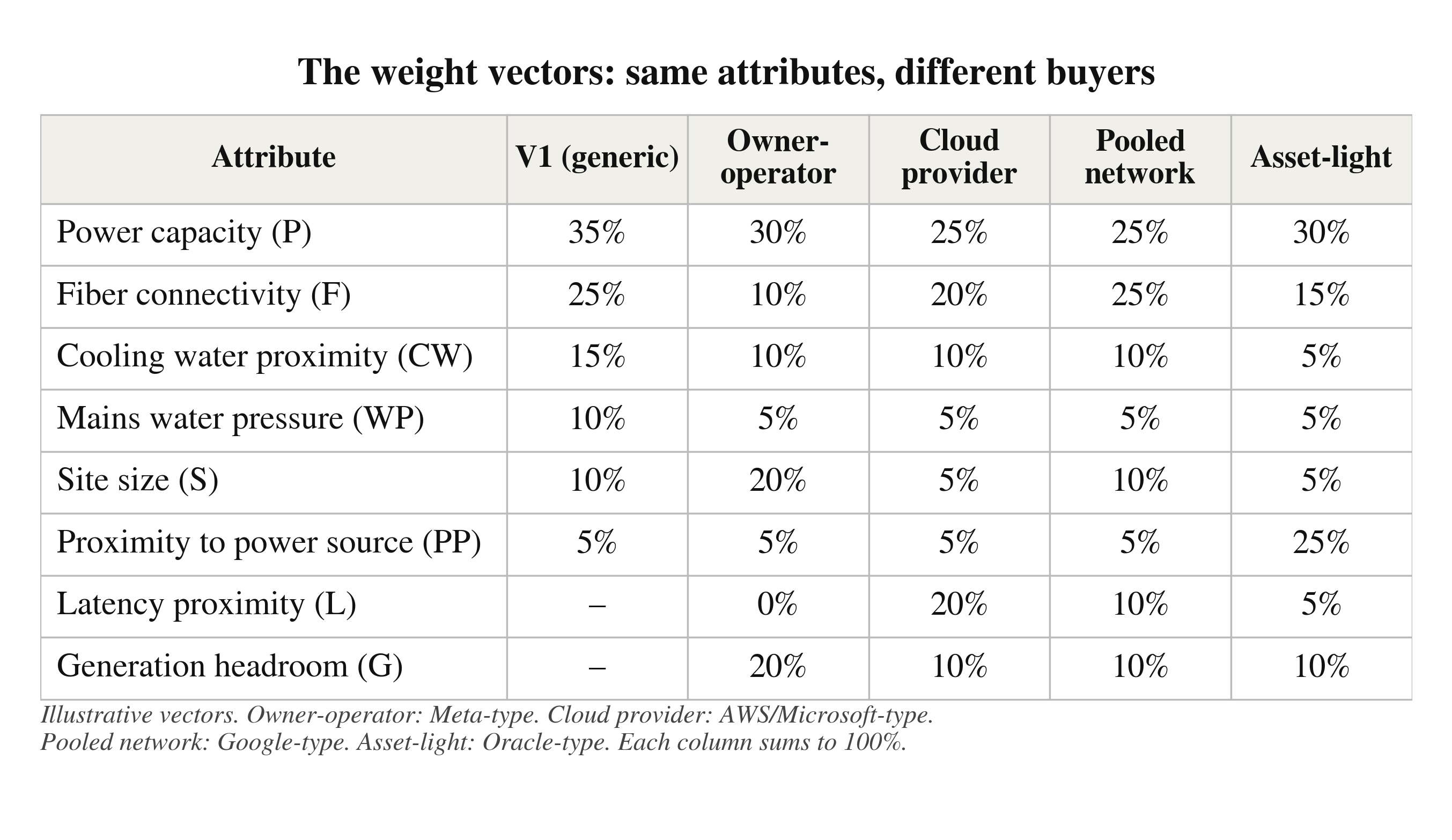
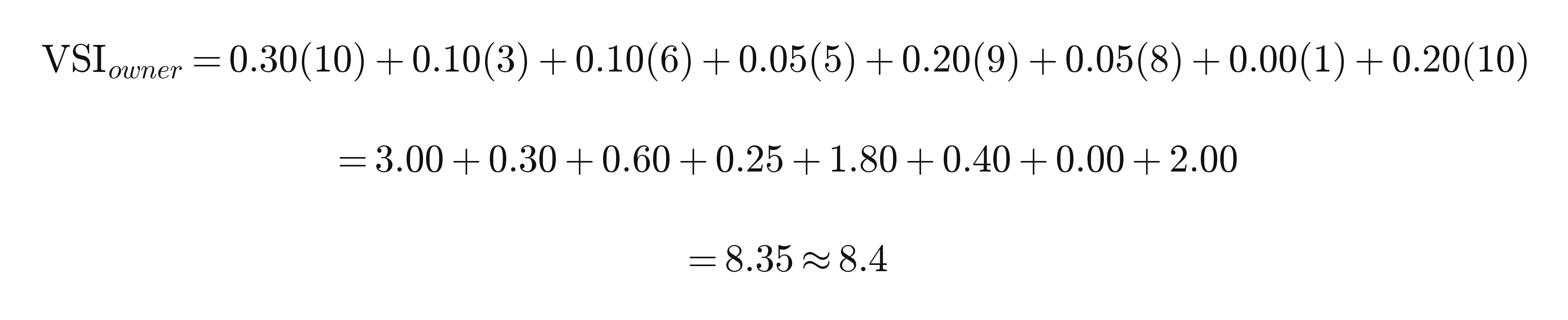
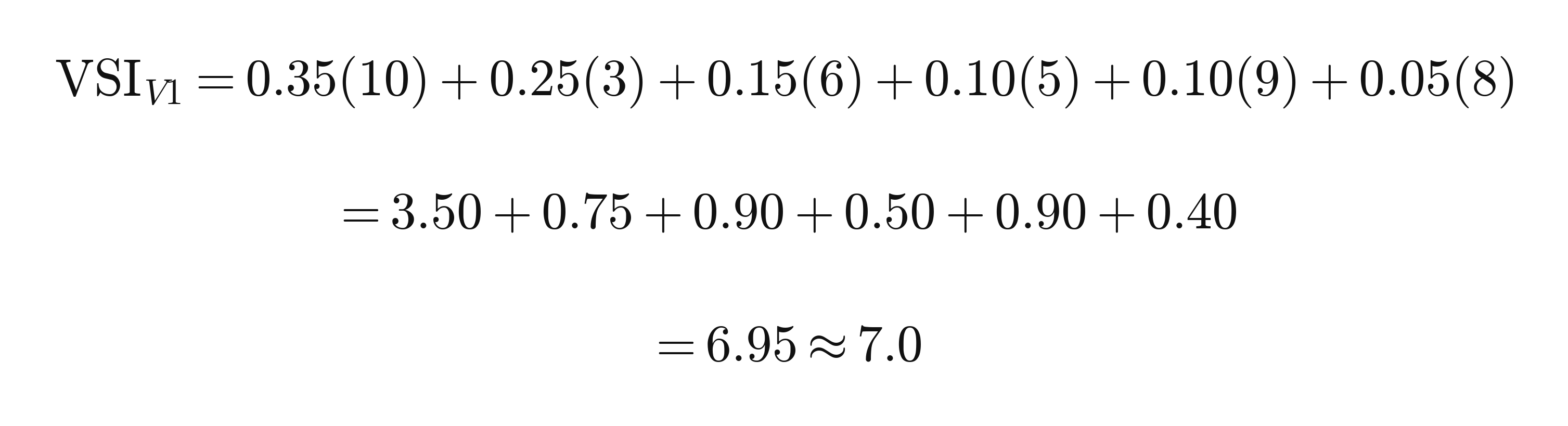
The building you end up with is just the weight vector made physical; a tent is a weight vector with nothing on redundancy, but a campus beside a nuclear plant is a weight vector with everything on it. In theory, you could nearly effectively read the buyer’s P&L off the architecture alone.
The max, not the mean
The part I got wrong by omission in my first version was the mispricing from assuming a generic buyer with universal needs.
A generic site score is effectively an average across imagined buyers. But a site doesn’t sell to the average buyer; it sells to its best-fit buyer. Its clearing price is set by the maximum:
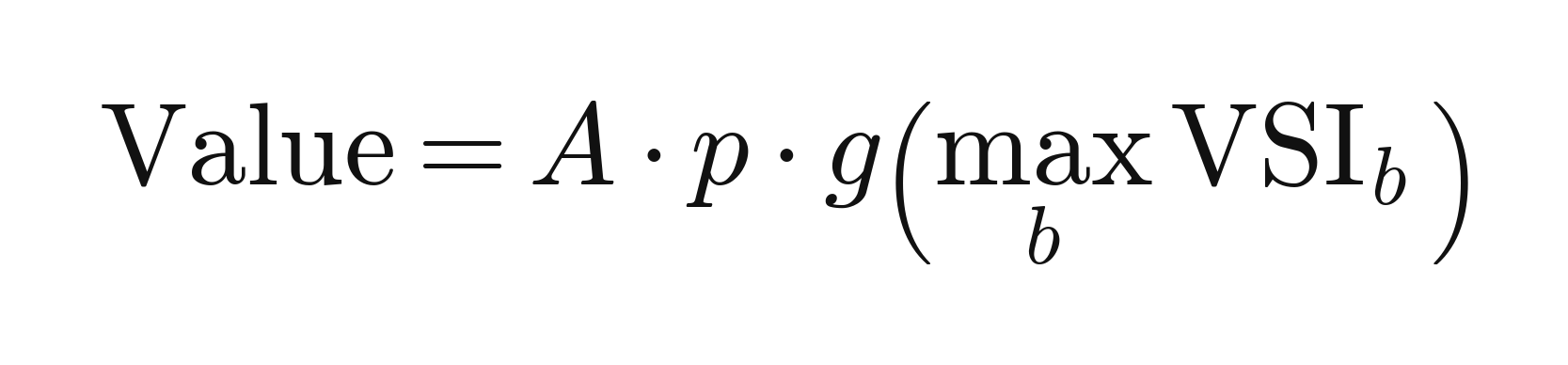
That gap between the max and the mean is the mispricing. And that gap is largest for exactly the sites generic scoring punishes hardest; a remote, no-redundancy, power-rich site scores terribly on average - four buyers wouldn’t touch it - and it’s precisely Meta-shaped. I made a version of this argument about converted crypto-mines a few weeks ago; the mines worth converting are a filter across a portfolio, not a score per site.

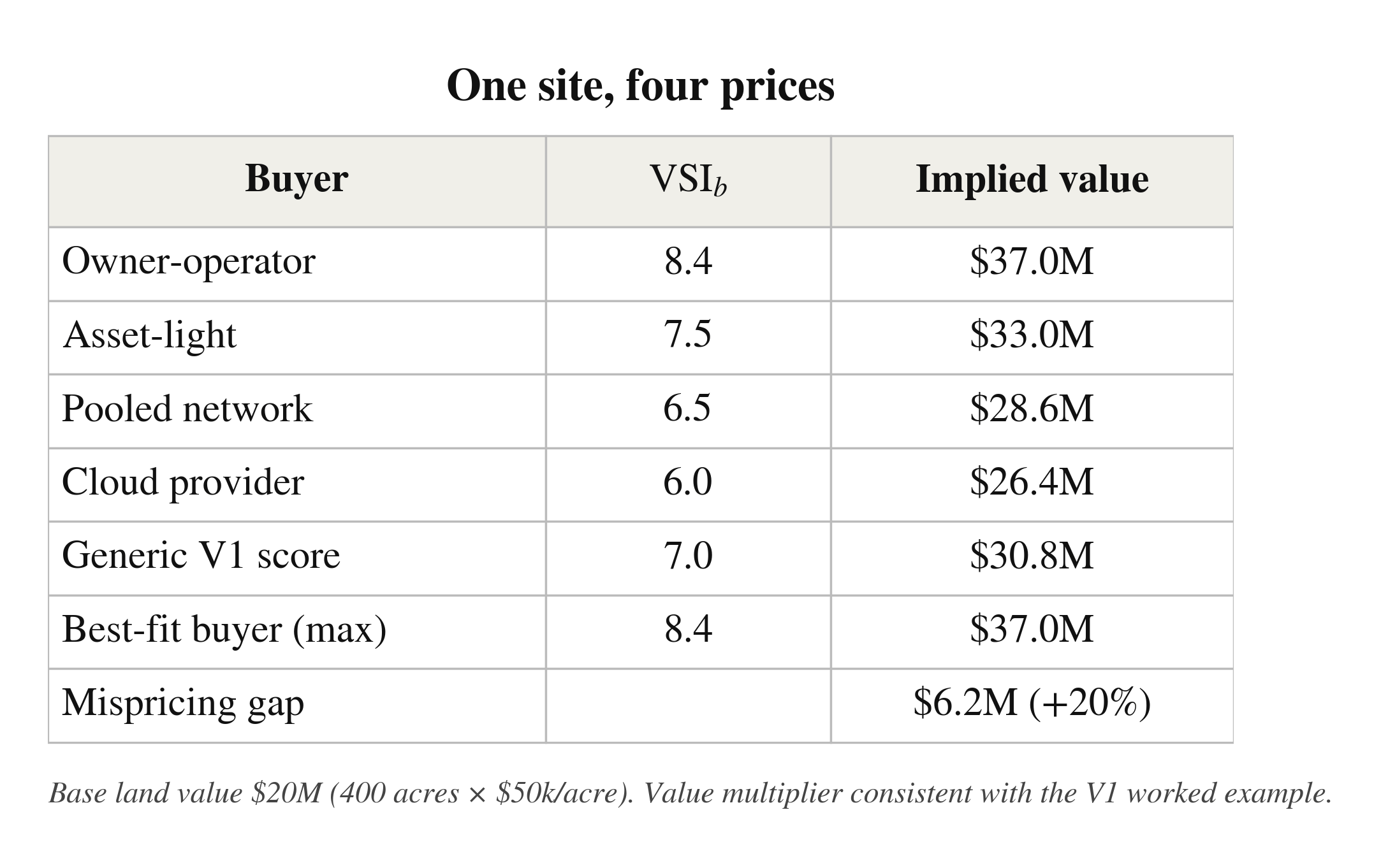
And this is the general case - one man’s dealbreaker is another man’s discount, and the sites everyone agrees are mediocre are the only ones that can really be defined as being valued correctly.
Declare your buyer
For valuers, the uncomfortable conclusion is that a site no longer has a value; it has a value surface, one number per plausible buyer, and the honest appraisal quotes the shape of it. For developers, “hyperscale-ready” is now a meaningless phrase, because there’s no generic hyperscaler to be ready for. You either spend heavily on optionality, or you pick your buyer early and build their weight vector into the ground around it. As owners of bare land attempt to market it’s viability for data center use, a strange site that every broker has scored a four out of ten could indeed be scored an eight by another party.
TH