
How Just-in-Case has replaced Just-in-Time in manufacturing
Redundancy has quietly become the biggest tenant in the warehouse market, but the cost of a cushion is more than just financial

Toyota gave the world just-in-time manufacturing, and for the best part of forty years it was treated as gospel. Hold as little stock as you possibly can, let the supply chain feed you the exact part, at the exact moment, on the exact day you need it. Inventory sitting on a shelf was seen as dead money, a sign of sloppiness, should always be optimised relentlessly towards zero. Running lean was a virtue - and everyone wanted to look lean.
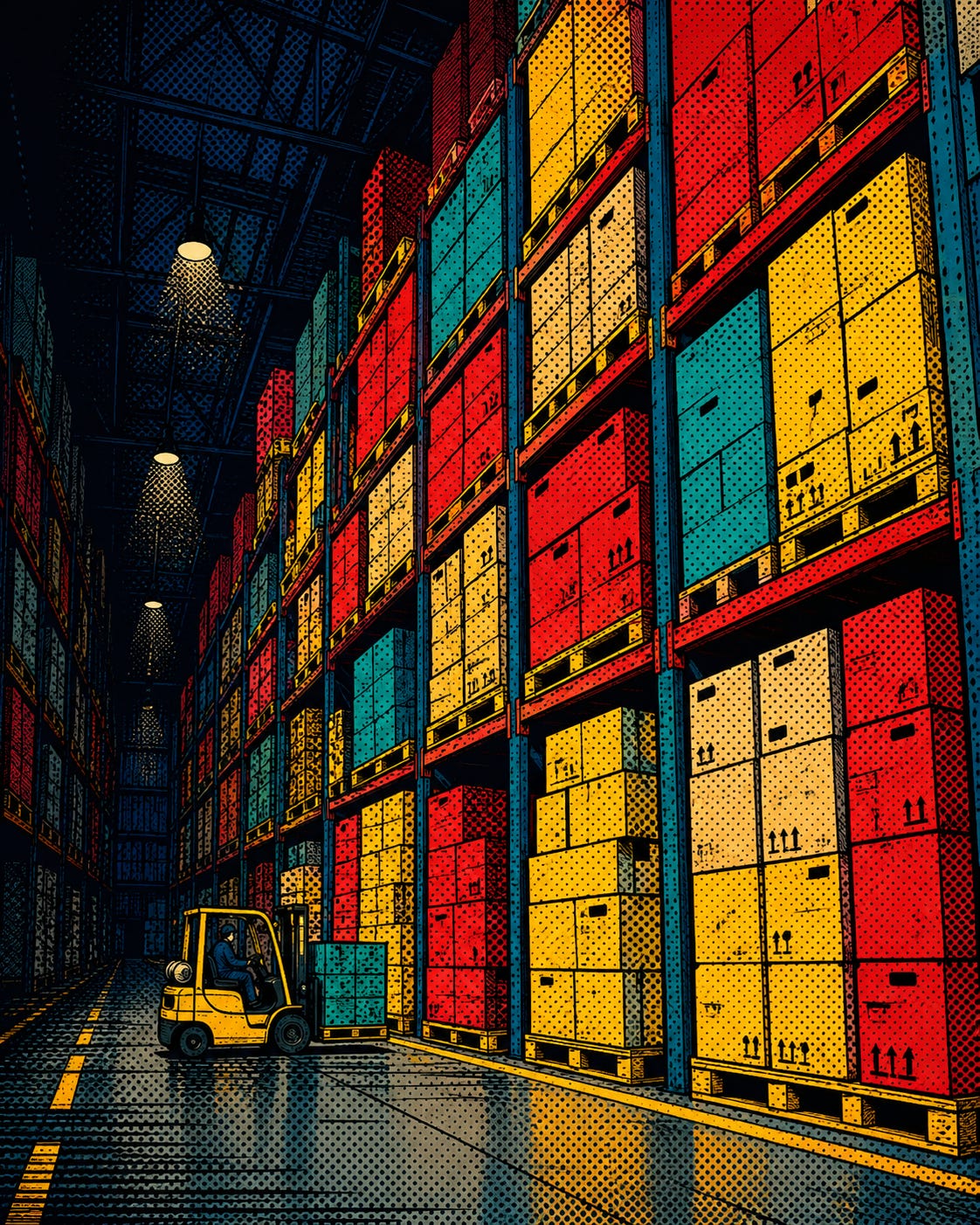
Then 2020 happened, and the gospel flipped. A blocked canal, a chip drought, half-empty supermarket shelves, and suddenly the company holding three months of stock looked clever rather than careless. “Just-in-case” became the new orthodoxy almost overnight.
Most of the commentary on that shift has generally framed the cost only really as a financial one. Working capital tied up in inventory. Carrying costs that the Institute for Supply Management puts at somewhere between 20% and 30% of inventory value every single year.
In theory, that’s all true, and all worth worrying about. But the premise skips the more interesting bill, that nobody’s really itemising. Every extra week of just-in-case has to physically exist somewhere; it needs a roof, a floor, dock doors and a postcode.
The redundancy cushion has quietly become one of the largest new tenants in the industrial property market; but unlike the money tied up in stock, the space it occupies doesn’t politely unwind once the crisis passes.
Lean has become a lot less lean
The numbers behind this shift are not subtle. By 2023, days inventory outstanding across S&P 1500 companies had climbed to roughly 71.6 days, a five-year high. Manufacturers, in particular, have held those swollen inventory-to-sales ratios fairly steady ever since rather than letting them drift back down towards the old lean baseline. Then tariff uncertainty through 2025 had firms pulling orders forward to get ahead of the next price rise, piling yet more onto the heap.
None of this reads like a temporary blip waiting to correct itself; and it appears more like companies institutionalising the buffer as a modern management practice. They’ve deliberately decided that carrying more is the price of not getting caught out again; but once a business makes that decision, the stock has to go somewhere other than a spreadsheet.
The interesting part: the ratchet only turns one way
There’s a bit I think gets overlooked in a lot of the commentary. The Just-in-time system has a correction built into it. Every quarter, somebody’s job is pushing inventory down to free up cash, and prove they’d trimmed the fat. The whole philosophy pulled in one direction, towards less.
But the Just-in-case system has no such floor. The incentives run entirely the other way, and they’re asymmetric. Nobody in a boardroom gets sacked for a warehouse that’s a bit too full, but plenty would get sacked if a shelf was empty during the one week demand spiked. When a disruption hits, buffers go up fast; and when the disruption fades, they quietly stay up because no one wants to be the person who stripped out the safety net right before the next shock. The redundancy capacity cushion ratchets. It perpetually seems to climb in every crisis, and barely retreats between them.
That changes what kind of demand this is; resilience-driven warehousing isn’t a cycle that booms and busts with the economy. It’s a step change that keeps stepping - a structural re-rating of how much space the physical economy needs just to feel safe. I accept the lean evangelists will push back hard on that, and in normal times they’d have a point. But we don’t appear to be in normal times.
Redundancy doesn’t add…it multiplies
The space problem is worse than “everyone’s holding a bit more,” because real resilience isn’t one bigger pile in one bigger shed. Genuine resilience is duplication - it’s dual-sourcing the same component from two suppliers on two continents. It’s decoupling buffers between each stage of production so a stoppage at one doesn’t starve the next. It’s spreading stock across more regional nodes so a single closed port or flooded motorway doesn’t strand your entire inventory in the wrong place.
Every one of those moves multiplies the number of locations stock has to sit in. Decouple a chain at five points and you’re no longer holding one buffer, you’re holding five, each needing its own building, its own racking, its own dock doors and its own staff to run it. Total floor space grows faster than total inventory value, because resilience by design scatters the same goods across more sites rather than consolidating them. You’re not simply holding more stuff. You’re holding it in more places, and places are the expensive part.
Fast space and slow space
Not all of this inventory behaves the same way though, and that’s reshaping what kind of buildings get built and where. Throughput stock (the stuff turning over constantly to feed e-commerce and next-day delivery) wants to be close to the customer. Companies pay a fortune for last-mile real estate near cities because speed is the whole point.
Safety stock is the opposite animal; it mostly sits still, waiting for a bad day that may never arrive. Parking that dead weight in premium urban logistics space would be foolish. Therefore, it heads for cheap, tall, heavily automated buildings out where land costs a fraction of the price, somewhere the rent on doing nothing is bearable. The global industrial real estate market seems to be splitting into fast space and slow space; two genuinely different property products with different economics, different locations and different tenants.
This is a big part of why nearshoring corridors are booming. Mexico pulled in over $20bn of foreign direct investment in a single quarter recently, with the largest slice heading straight into manufacturing, and inventory markets like Monterrey have swelled to north of 200 million square feet of industrial space. Shorter, more resilient supply lines need somewhere to hold their buffers, and it’s better to put that expense where the concrete and the ground underneath it is a cheaper liability.
The cost with no line item
So why isn’t anyone properly pricing all this?
Simply put: there’s no row in the accounts called “resilience.”
The inventory itself shows up neatly on the balance sheet, a number a finance director can quote to two decimal places, but the space holding it does not. It’s operating expense is split - smeared across the cost of goods, buried inside a third-party logistics invoice, or hidden in a lease that looks like healthy growth on paper - but is really just insurance against the next disruption. A company can tell you precisely what its stock is worth and have almost no idea what its cushion costs in rent, because that cost isn’t ever gathered into one place to be costed properly.
The cost of a cushion is more than financial precisely because the financial bit is the only part anyone bothered to measure. The square footage, the energy to light and heat it, the people to run it, the opportunity cost of capital sunk into a building full of stuff that’s deliberately not moving, all of it lands as a vague, distributed drag that never gets named – and you can’t manage what you refuse to add up.
Building less, charging more
The supply side is what turns this from an interesting observation into a genuine squeeze. Warehouse construction peaked in 2022, with something like 2,784 facilities entering the building stock, and completions topping 330 million square feet at the height of the cycle in 2023. Then it fell off a cliff. New supply slumped to around 48 million square feet in the first half of 2025, and speculative developers seem to have largely abandoned distribution centres in favour of building data centres instead.
A structural step-up in resilience demand is therefore arriving just as the pipeline of new space thins out. Vacancy has stabilised somewhere around the high-six to mid-seven percent mark depending on whose methodology you trust, big-box leasing more than tripled year-on-year in early 2026, and pricing power is creeping quietly back towards landlords.
The winners are obvious enough: owners of modern, high-cube, automated space in cheap secondary markets, and the nearshoring hubs soaking up manufacturing that’s moving closer to home. The losers are less obvious and a lot more deserving of sympathy. They’re the lean disciples who proudly handed back their buffer space in 2023 to look efficient on a quarterly call, and now have to re-lease it into a tighter, dearer market at the worst possible moment. There’s a grim little irony in the efficiency crowd now being forced into paying an efficiency penalty.
The cushion you can measure
The cushion isn’t going anywhere this decade. Tariffs, geopolitics and the lingering memory of bare shelves seem to have cemented that for the foreseeable future. But leasing ever more space is the lazy response, and it’s the one that quietly bleeds a business while hiding in the cost of goods.
The same research showing buffers ballooning also shows firms running AI-driven demand sensing cutting their safety stock by somewhere between 30% and 50% for the same level of resilience. That’s the real opportunity, and it’s the one the next ten years will reward.
The companies that come out ahead won’t be the ones sitting on the most stock in the most buildings. They’ll be the ones who know, almost to the pallet, how little they can hold and still sleep at night. Resilience you can actually measure is resilience you can deliberately shrink. Everyone else is just paying rent on their own anxiety, and calling it strategy.
TH
You may find these of interest:
The Elephant on the Quay: Can Shelf Prices Survive the Sea?

In previous articles, I've spent a fair amount of words arguing that the power grid is the real bottleneck of most industries; and in specific, the archaic infrastructure and grid network. Decades underinvested, a queue of projects nobody can connect, and every clever idea downstream of it eventually choking on the same constraint.
Divide & Conquer: Decentralized manufacturing could be the saviour for both employment and commercial real estate

Have we reached peak manufacturing efficiency? If we’re brutally honest, there’s only been a handful of true leaps in progress over recent years. There was obviously the industrial revolution and the production line; industrialised automated manufacturing methods; and more recently robotics and AI integration.
Medical device companies could deliver market domination by using the Bloomberg playbook

Whilst there are many success stories of businesses in the latter part of the 21st Century, one remarkable achievement is that of Michael Bloomberg, who has managed to create, retain, continue to monetize, and develop a significant indispensable piece of technology for every financial institution in the Western world.