
Diesel Do Nicely: An Honest Audit of British Hydrogen
Hydrogen’s engineering has delivered on nearly every promise. Its policy hasn’t delivered on any of them.

In December 2025, bp withdrew its planning application for H2Teesside, a 1.2 GW hydrogen plant that would have delivered roughly a tenth of the government’s entire 2030 production target. It pulled out days before a decision was due, after part of its land was granted planning permission for a 5 million sq ft data centre instead.
Months later, in March 2026, Dawsongroup bought the world’s first JCB hydrogen generator and put it straight to work as standby power for a data centre customer.
That’s a strange dichotomy - a data centre killed Britain’s flagship hydrogen project, and another became hydrogen’s first paying generator customer.
If you build, operate or finance data centres, both sides of that story are equally as relevant. Every operator is sitting in a grid connection queue that now exceeds 100 GW against a national peak demand of about 45 GW; and nearly every operator runs a diesel standby fleet it’s under pressure to decarbonize.
Hydrogen gets pitched at both problems constantly, but never quite makes it onto the asset register.
The Teesside winter tells an interesting tale here: Hydrogen’s fate was never going to be decided by its own price tag; it’s decided by the price of the thing it replaces.
Judged against that test, the technology is in better shape than its critics claim, but equally is in far worse shape than its strategy documents assume.
Standby Me
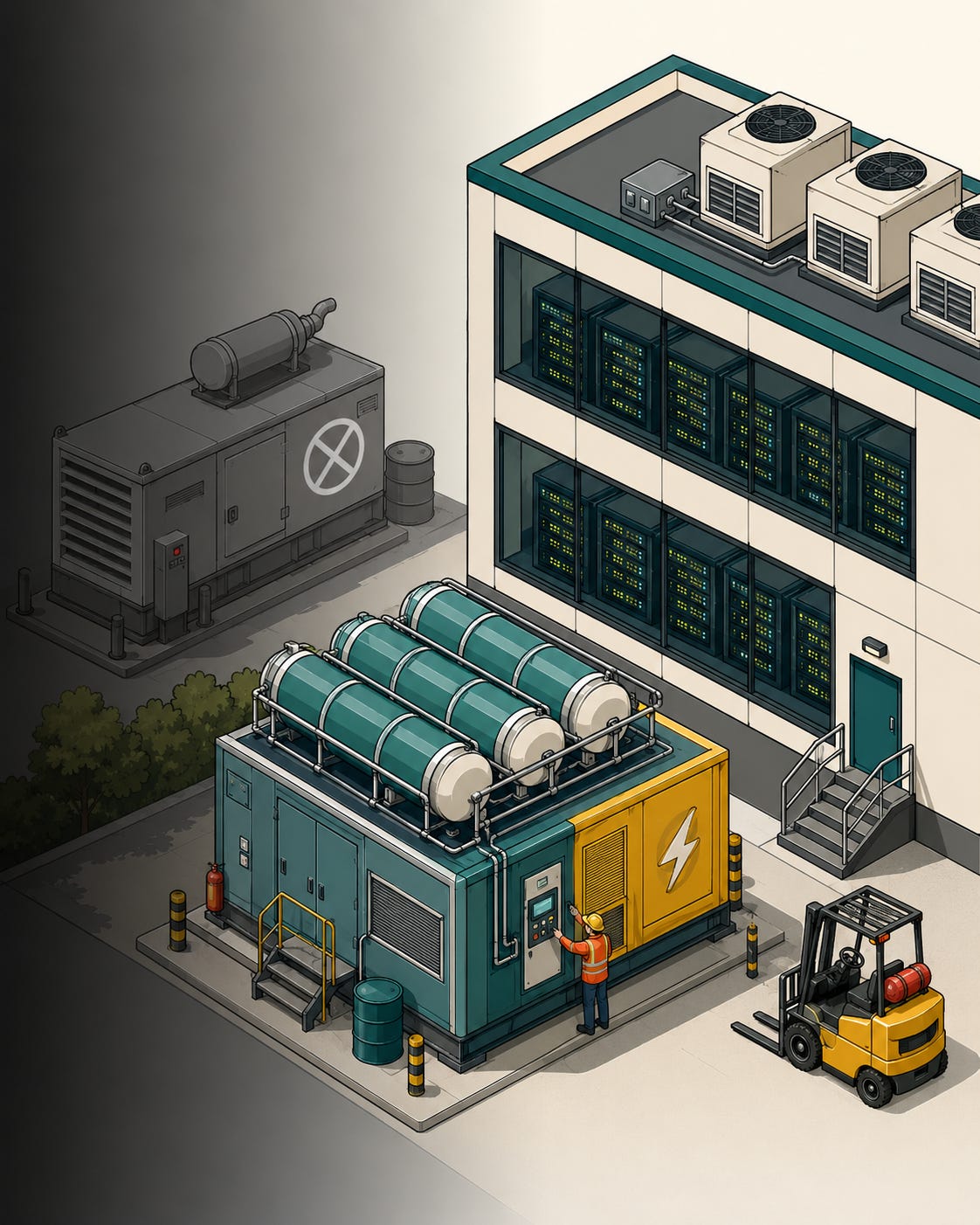
The JCB G60RS H is the world’s first production hydrogen genset, and its first buyer was Dawsongroup, who dropped it into a rental fleet alongside 155 diesel units and deployed it on standby duty at a data centre. The design pairs the engine with a battery pack so it only fires at peak or to recharge; effectively a mild hybrid drivetrain (similar to what’s in a lot of modern hybrid vehicles), but ran in reverse. Behind it sits a serious engineering programme: £100m ($130m), a team of around 150 engineers, and in May 2025 the first full EU type approval ever granted to a hydrogen engine in non-road machinery.
What impresses me more than the machine is that the Bamford family has assembled the entire supply chain around it, privately, whilst all attempts of the UK state version never got out of the starting blocks:
Production. Hygen’s Bradford electrolyser plant (in construction) and Ryze Power’s distribution fleet, both under Jo Bamford’s HydraB group.
Refuelling. HYKIT, a JCB/HYCAP/HydraB joint venture, whose mobile unit carries 75kg and turns a machine around in fifteen minutes.
Demand. JCB’s own hydrogen machines, in series production since June, with National Highways contracting 2,500 tonnes for the Lower Thames Crossing to displace twelve million litres of diesel.
Finance. JCB Finance leasing the kit with a service contract, so no customer carries the residual risk of a novel asset.
That’s a complete miniature hydrogen economy, built by one family, without waiting for an allocation round.
The scale ceiling is rising, too. INNIO, the Austrian engine maker behind the Jenbacher gas engines that already power a 60 MW off-grid plant for a Dublin hyperscale data centre, ran a 3 MW engine on 100% hydrogen in April 2026, tested against the fast, violent load swings that AI training clusters produce. Technical staff from Microsoft, Google and Data4 witnessed it. The people who buy data centre power physically watched a hydrogen engine pass their own test.
So at this point, we can initially conclude Hydrogen’s unpopularity isn’t a technology problem, and the engineers have done some phenomenal work.
The Allocation of Blame
So there’s no professional blame from me; but I will blame policy.
The UK’s first Hydrogen Allocation Round committed £90m ($117m) of capital and over £2bn ($2.6bn) of revenue support to eleven production projects totalling 125 MW. One is operating: GeoPura’s HyMarnham in Nottinghamshire, on the site of a former coal plant, running since January. The second round shortlisted 765 MW in April 2025; fifteen months later the Invite to Offer stage still hadn’t opened, and when asked in the Commons this July whether it would open before year end, the minister answered that the department was “working hard” to start it “as soon as possible”. The refresh of the national Hydrogen Strategy, due autumn 2025, remains unpublished. The Hydrogen to Power business model, the mechanism that would let hydrogen generation actually earn revenue, was promised as operational by 2026; I can’t find any evidence that it exists (there again, I’m just a bloke using Google – but I still haven’t found it after a lot of searching).
Investors have drawn their own conclusions. SSE took a £21.8m ($28m) write-down and paused its hydrogen production projects, citing “material policy delays”. ScottishPower paused two schemes despite having already signed HAR1 funding agreements; they walked away from subsidy they’d won. Hydrogen’s share of global energy venture capital has fallen from 13% to 4% in two years.
Sitting Tenants
The difference is the incumbent. Run hydrogen against the three duty cycles a data centre or construction programme actually buys, and the pattern explains both halves of Teesside.
Grid-connected prime power: hydrogen loses heavily. The incumbent is industrial electricity at roughly £150–250/MWh ($195–325). Hydrogen through a fuel cell, at the £9.50/kg strike price HAR1 contracted, at current rate is estimated to cost £360–570/MWh ($470–740) in fuel alone. No learning curve fixes this; hydrogen made from electricity can’t undercut the electricity it came from once you’ve lost two thirds of the energy in the round trip. [Caveat: A hydrogen engineer may quote higher on HHV (Higher Heating Value) with generous fuel cell assumptions, but the underlying principle is still the same].
Fixed standby at a single site: hydrogen loses on capital, not fuel. A standby set runs perhaps fifty hours a year, so expensive fuel barely registers, and anyone waving a £/kg figure at a backup fleet is making a category error. The problem relocates to capital expenditure: on a 100 MW site, illustratively, £276m of fuel cells against £42m of diesels ($359m vs $55m), with no notable fuel saving to claw it back. This is also where Hydrotreated Vegetable Oil already won; a drop-in renewable diesel, 90% of the carbon benefit, same tanks, same engines.
Off-grid and temporary power: hydrogen wins now. The incumbent is a hired-in diesel set at £400–800/MWh ($520–1,040) all-in, the most expensive electricity routinely bought in Britain. Hydrogen clears that bar today, and the capital objection dissolves because the asset usually lives in a rental fleet, amortised across many sites. This is precisely the Dawsongroup model, and why the first commercial hydrogen genset in the world went to a plant hire company, rather than a utilities provider.
This distills into one pattern, arrived at through three verdicts:
Hydrogen’s viable territory is wherever the incumbent is most expensive, and the incumbent is the most expensive in the small, mobile, off-grid applications.
A national strategy built around gigawatt production plants was optimised for the exact end of the market where hydrogen loses.
My previous article on turbine generation made a related point about buying supply chain position rather than queueing; and it’s a similar point here - the position worth buying is the duty cycle, not the plant.
Teesside Story
The causation of the failure at H2Teesside was a little more layered and nuanced. Realistically, they had already lost its anchor customer as soon as Sabic closed the Wilton petrochemical cracking plant. Meanwhile, bp had also scrapped its neighbouring green hydrogen scheme months earlier as part of a wider retreat to oil and gas. From a surveying and consultant’s perspective, my read is that the dispute over the land just forced a decision that bp was already minded to make.
But if we dissect it, there were two stated national priorities: AI infrastructure and hydrogen production. They competed for the same 115 acres of the scarcest asset in modern infrastructure: energised, consented, connected land (my previous article covers why that’s currently the real currency).
Dig into the paperwork, and you’ll see that bp argued the two could have coexisted under HSE rules (had the data centre been kept below two storeys); it says its offers to meet were ignored; the council granted permission; and then bp withdrew before ministers ever had to choose. There was no mechanism to arbitrate, no way to price what was being displaced, and so the decision was made by default. A 1.2 GW project producing a tenth of a national target died without anyone in government ever ruling on it.
The incumbent test applies to land too. On that site, the sitting tenant with the better economics was the data centre. In comparison, the competitor hydrogen plant wasn’t even close to matching it.
Scale Model
The limits, stated plainly: off-grid and standby duty is a real market, but it isn’t the hydrogen economy the strategy assumed. A construction programme burns tonnes; while a hyperscale campus can burn tonnes an hour. When Ofgem awarded 7.6 GW of long-duration storage contracts this year, not one went to hydrogen. To add insult to injury, the niche could yet be eaten from below by Hydrotreated Vegetable Oil and batteries.
But Britain is provably good at the part that works. We hold Europe’s first hydrogen engine type approval. We built the first commercial hydrogen genset and sold it into the first data centre. GeoPura built the one production project that runs, and has now agreed a £275m ($358m) sale to a Canadian buyer (a common way how these stories tend to go..!).
The engineers have done their job, but it’s now down to policy to fund the duty cycle that pays, rather than the tonnage that impresses. And it should try and do it before the rest of the working half gets bought by someone with a bit more foresight.
TH